Almost Out of Mana is a compact tactical puzzle game built around a simple problem: a wizard has very little magical energy left, yet every enemy on the board must be defeated. Released on 24 March 2026 by solo developer Ovidiu Tepes of Crevasse Studios, the game turns spell selection into a sequence-planning challenge rather than an action battle. Each spell has a clear purpose, each cast consumes a limited resource, and a poor opening move can make the rest of a level impossible. Its spellbook gives the experience a card-like rhythm, but it is important to describe the game accurately. There is no collectible deck, random booster system or long deck-building campaign. Instead, players work with a defined set of magical actions and solve handcrafted encounters at their own pace. This focused design makes Almost Out of Mana suitable for short mobile sessions while still demanding careful observation, basic calculation and an understanding of how different spell effects interact.
What Almost Out of Mana Offers in 2026
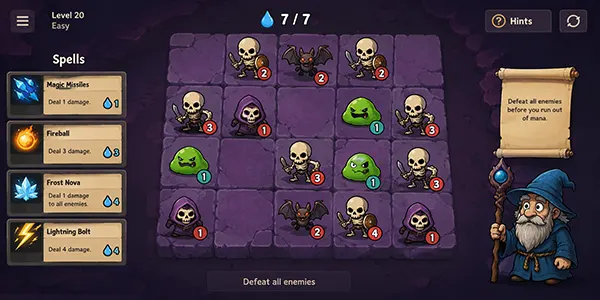
The central objective is consistent across the game: remove every enemy before the mana supply reaches zero. A level presents a fixed arrangement of creatures, visible spell options and a limited amount of magical energy. The player must decide which target to attack first, when to use a wider effect and how to avoid spending an expensive spell on a problem that a cheaper one could solve. There is no countdown forcing a quick response, so the pressure comes from scarcity rather than speed. This distinction matters because Almost Out of Mana rewards planning more than reflexes. A player can pause, compare possible sequences and restart after identifying a mistake. The design resembles a small tabletop puzzle in which all essential information is placed in view and the challenge lies in using it efficiently.
The story is deliberately light. The wizard is trying to recover a stolen pair of lucky pants, giving the campaign a comic motive without interrupting the puzzles with long dialogue or heavy world-building. Enemies are presented as expressive obstacles rather than characters in a complex narrative, and their visual reactions help make repeated attempts feel less dry. This restrained approach supports the main idea: the game wants the player to think about the board, not memorise a large fantasy setting. The humour also softens the consequences of failure. Running out of mana does not feel like losing a serious role-playing battle; it feels like reaching the wrong answer in a logic problem and trying again with a better sequence.
As of July 2026, Almost Out of Mana is available through the App Store and Google Play, with a Windows release also listed by the developer. The standard price is around US$2.99, although local pricing differs by country and occasional store discounts may apply. It is sold as a premium game rather than a free download supported by adverts or repeated purchases. The developer states that it contains no adverts, no in-app purchases, no tracking and no data collection. That model gives the game a clear boundary: the purchase provides the full set of available content and future updates are not presented as paid progression. For players tired of energy timers, daily reward chains and intrusive shop prompts, this is one of its most practical advantages.
How the Spell System Creates Card-Like Decisions
The card comparison comes from the way spells function as separate tactical tools. Each one can be understood as an action card with a mana cost, an attack pattern and a specific result. One spell may be efficient against a single durable creature, while another becomes valuable only when several targets can be affected together. The challenge is not merely choosing the strongest attack. It is matching the shape and cost of a spell to the current arrangement of enemies. Because the mana total is deliberately tight, wasting even a small amount may remove the only successful route through the level. This creates the familiar card-game question of value: how much useful work does one action produce for the resource spent?
Unlike a conventional deck-building game, Almost Out of Mana does not rely on drawing a lucky hand or collecting stronger cards over many hours. Its official description emphasises a diverse spellbook, handcrafted levels and pure tactical play. In practice, this means the puzzle is built around known tools rather than uncertain access to them. The player is expected to study the available spells and work out the intended order. That structure reduces randomness and makes failure easier to understand. When a level goes wrong, the cause is usually a target choice, a badly timed area effect or an inefficient use of mana, not an unlucky draw. The result is closer to a sequence puzzle with card-like commands than to a traditional collectible card game.
The system remains approachable because the rules are communicated through visible outcomes rather than pages of statistics. Players do not need to manage equipment sets, character classes, crafting materials or a growing inventory. The important questions are immediate: which enemies can be hit, how much mana will remain and what spell must be preserved for later? New mechanics can be introduced through additional spells or enemy behaviour, but the basic language stays consistent. This helps the game add difficulty without becoming overly technical. A level may take several attempts, yet the player is usually dealing with a small number of understandable choices rather than an overwhelming menu of upgrades.
Why Limited Mana Makes Every Level Tactical
Mana is not simply an energy bar placed under a combat system; it is the rule that gives each puzzle its structure. In many fantasy games, running low on magical energy is a temporary inconvenience solved by waiting, using an item or switching to another form of attack. Almost Out of Mana removes those escape routes. The available mana is the budget for the entire encounter, and every spell is an expense that must contribute to the final solution. This encourages players to think in complete sequences. A move that looks effective on its own may be wrong if it leaves too little energy for the final enemy. The correct question is therefore not “What can I defeat now?” but “What order lets me defeat everything?”
Enemy placement adds another layer to that calculation. Groups invite area attacks, isolated targets may require precise damage, and different reactions can change which creature should be handled first. The developer describes the enemies as distinct and designed to alter the way players think, so later boards are not meant to be solved by repeating one favourite combination. As the number and strength of enemies increase, the player must compare several possible openings before committing. A powerful spell may be most efficient at the start, after targets have been prepared, or near the end as a finishing move. The same tool can therefore have different value depending on timing and position.
The absence of a timer gives this tactical structure room to work. Players can inspect the board, calculate the remaining mana and consider alternatives without being punished for thinking slowly. This makes the game suitable for people who enjoy strategy but do not want the intensity of real-time combat. It also fits brief journeys or quiet breaks because progress is divided into individual handcrafted levels. A player can solve one puzzle and stop without abandoning a long mission. At the same time, the relaxed pace should not be mistaken for low difficulty. Store reviews and professional coverage both describe levels that require repeated thought, especially when a seemingly reasonable spell order fails near the end.
Practical Ways to Solve Difficult Boards
A reliable first step is to read the whole board before casting anything. Note the number of enemies, their relative durability, their positions and the mana cost of every available spell. Then identify effects that can damage more than one target or create value through a special pattern. These options often determine the rest of the solution because their efficiency depends on using them at the right moment. Starting with the nearest or weakest enemy can be tempting, but that choice may break a useful group or consume mana needed elsewhere. Treat the opening spell as the foundation of the sequence rather than an isolated attack.
It also helps to work backwards from the final enemies. Ask which spell can finish each remaining target and how much mana that ending requires. Once the closing cost is clear, the earlier actions can be judged by whether they leave enough energy for it. This method prevents a common failure in resource puzzles: reaching the last creature with an impressive amount of damage dealt but no legal way to complete the board. When several spells appear interchangeable, compare their total value rather than their headline strength. A cheaper attack that leaves an enemy ready for a later area effect may be better than an expensive spell that removes one target immediately.
Restarting should be treated as part of the design, not as a punishment. A failed attempt reveals information about spell ranges, enemy reactions and the point at which the sequence becomes inefficient. Rather than repeating every move, change the earliest decision that created the shortage. The game also includes hints and a guide for players who become stuck, which can keep a difficult level from blocking the entire experience. Using a hint after several thoughtful attempts is more useful than guessing randomly, because the aim is to understand the logic behind the board. Once a solution is found, replaying it mentally can clarify why the order worked and make similar mechanics easier to recognise later.
Presentation, Accessibility and the Current State of the Game
Almost Out of Mana uses clean, minimal artwork with bold enemy expressions and a clear separation between the board, spells and mana information. The visual style supports quick reading on a smaller screen, which is important in a game where placement and remaining resources must be understood at a glance. The presentation is playful rather than dramatic, matching the wizard’s search for his lucky pants and the exaggerated reactions of the creatures. Music and sound effects provide feedback without turning the game into a noisy action title. The overall result is modest in scale but coherent: every visual element serves either the puzzle or the humorous tone.
The developer lists several accessibility options, including a contrast mode, reduced motion, haptic feedback and support for multiple languages. The official site states that the game is localised in seven languages, while the App Store also notes support for differentiating information without relying on colour alone, sufficient contrast and captions. These features are especially relevant for a title based on recognising targets, effects and state changes. Reduced motion can make repeated spell animations more comfortable, and contrast settings can improve clarity when several creatures share the screen. The game also provides hints, which function as both a difficulty aid and a way to prevent progress from becoming inaccessible after one difficult board.
The 2026 release has already received several updates. App Store version history shows that leaderboards, challenges and achievements were added early, followed by fixes affecting levels 15 and 19 and a reduction in the difficulty of level 20. The Android listing was updated on 8 April 2026. These changes indicate that the developer responded quickly to progression and clarity issues after launch. Current store information also shows a small installation size on iOS, about 39.4 MB, and an age rating of 9+ because of infrequent cartoon or fantasy violence. Game Center features apply to the Apple version, so players should not assume that every social function is identical across devices.
Who Is Most Likely to Enjoy Almost Out of Mana
The game is best suited to players who prefer compact logic challenges, visible rules and deliberate resource management. It works particularly well for those who enjoy the decision-making of card games but do not want to build decks, study a large competitive rule set or depend on random draws. The premium price also makes sense for people who value an uninterrupted experience without adverts or recurring purchases. Since levels can be approached one at a time and there is no timer, the game fits short sessions while still offering enough resistance to make a solved board satisfying.
It may be less suitable for players expecting a long role-playing campaign, extensive character development or the constant novelty of a large deck-building roguelike. Professional reviews have praised the focused puzzle concept but also noted that the central idea can feel limited after the initial surprise and that experienced puzzle players may finish the available content relatively quickly. Some store users have reported bugs, including progression problems and controls becoming unresponsive, although the experience appears to vary by device and several level-specific issues were addressed in early updates. These drawbacks do not invalidate the design, but they are relevant when judging the purchase.
In its 2026 form, Almost Out of Mana is a small, clearly defined strategy puzzler rather than a broad fantasy adventure. Its strongest feature is the connection between spell cost, target order and limited mana: every action must support a complete solution. The card-like spell system provides distinct choices without the complexity of deck construction, while the absence of timers allows each board to be considered carefully. Its value therefore depends less on total playing time than on whether the player enjoys solving precise tactical sequences. For that audience, the game offers a thoughtful premium experience with accessible controls, a light comic identity and a design that respects both attention and time.