Scrongly turns poker hands into the engine of a deckbuilding roguelite. Developed and published by Silver Dubloons, it was released on Steam on 1 October 2025 and remains free to play in 2026. The idea is simple: build scoring hands, earn chips, strengthen the run and reach each target before the deck is exhausted.
How Scrongly reshapes familiar poker rules
The game starts with recognisable poker logic but does not simulate a cash table or tournament. Hands work as scoring patterns inside a single-player run. The rules can bend far beyond conventional poker: the official description mentions one-card straight flushes, seven-card hands and deck-destroying bombs.
This matters for readers who know poker through gambling sites. Scrongly uses card-room language, yet it is a free videogame built around repeated runs and deck construction. The contrast is clear beside an online casino site: nolimit-way-casino.com belongs to the gambling category, whereas Scrongly is presented on Steam as a free single-player game, not a real-money poker product.
Each round asks the player to reach a score threshold before running out of cards. Efficient scoring awards chips, which can then be spent in the shop. A straight, flush or other hand is useful not because it wins a pot, but because it helps build enough score and resources for the next stage.
Deck changes, Zodiacs and Baubles
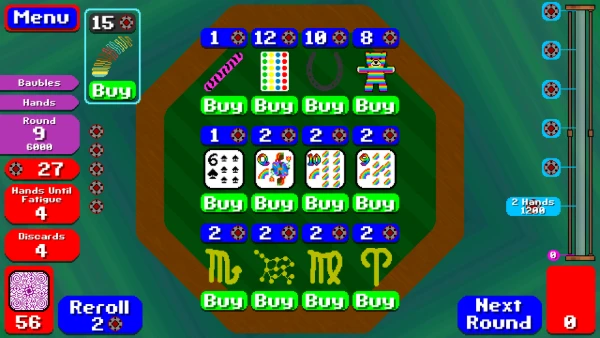
The shop adds the deckbuilding layer. New cards can be added, including special ones with effects outside standard poker. Lucky 7, for example, can trigger a slot-machine spin that uses the player’s own deck as the reels. Familiar gambling imagery becomes a videogame mechanic rather than a wagering feature.
Zodiacs improve played hands that contain a specified hand type. This lets a player invest in one scoring route without being locked into it later. Baubles change the rules more directly. The Ladders item, for instance, allows gaps inside straights, making combinations possible that ordinary poker would reject.
Deck management therefore matters more than memorising a fixed poker chart. A run may begin with straightforward combinations and move towards unusual hands created by upgrades, special cards and altered rules. The core remains readable for newcomers, while changing synergies leave room for planning.
Why poker works well as a roguelite
Poker already depends on probability and decisions made with limited cards, so it adapts naturally to run-based design. Scrongly makes each attempt temporary. If the score target is not reached before the available cards are gone, the run ends, and the next attempt can develop very differently.
The game includes ten difficulty levels, boss rounds, daily games with unusual variants and a custom game creator. These modes extend the challenge without changing the basic loop. Players can learn ordinary runs first, then move towards harder settings or rule variants.
Steam lists Windows 10 version 21H1 or newer, 8 GB of RAM, a DX10, DX11, DX12 or Vulkan-capable GPU and 150 MB of storage as the minimum. Full controller support is listed, while Steam Deck compatibility remains marked as unknown at the time of writing.
A small free game with its own identity
Scrongly openly names Balatro as an inspiration, but its mechanics are distinct. One-card straight flushes, bombs, Zodiacs, Baubles and seven-card scoring hands push it towards deliberate rule-breaking rather than strict traditional poker. Its compact format suits short sessions.
As of 2026, Scrongly is available free on Steam and through the developer’s itch.io page. Steam lists Silver Dubloons as both developer and publisher. A March 2026 Steam Community update shows that fixes continued after release, including a localisation correction for number formats on some systems.
The appeal is clear: poker combinations provide a familiar base, while roguelite upgrades keep changing what those combinations can do. Scrongly does not require real-money play or detailed knowledge of competitive poker. It treats poker hands as flexible building blocks for a repeatable strategy game.